Pages

Tuesday, April 15, 2008

HUMOR: Tinuod Nga Botbot ( True Lies)

Photobucket
I came across a site last week and I decided to make post as a tribute to the brand of humor-dialect-culture that is Cebuano/Visayan.

One word that makes it so distinctive, expressive, and without par in the entire archipelago. The word means dark. In tagalog madilim. In the local dialect it goes 'ngit-ngiiit'!

One word says it all.

Kumusta diay sa akong mga parenti diha sa Cebu. Si Tiyo nako nga Vicente ug akong ig-agaw tagsa, si Ging-ging, usa ka matahum nga doktora. Ayaw gyud nag tinuntuhi ninyo ha? Dila ray way labud ninyo(j/k)!

***warning though, site contains explicit language. Click on image to go to site...

Monday, April 7, 2008

Blogging 101: Attitude

Photobucket

hey dude, i started blogging last january.
its april now so it seems.
relatively new, you would say.

since then, i've had some form of fun.
as long as it's not work for me.
so what's your blogging style BTW?
do you like exposing your undies online?
or are you very private like me?

just a few days ago, i went on some rolling blitz.
just browsing other blogs in bloogle..mostly.
finding how others blog their world away.

there was this blog by someone,
a graduate of law like me.
there were pictures of her in scantily clad clothing..
hmmm..sexxxy! i should say..

its not that i'm ugly or a supreme court (with no appeal).
i had my share..more than enuf i should say.
its proly cause i was just not brought up that way.
i just can't bring myself to pose in the frontpage of a magazine.
neither do i think is my private home/life (would be) of any interest to you.
anyway...

i don't like poetry either.
don't make me decipher for meanings.
and don't waste my time on those.
i'm very greek, cause for the greeks
presence was immediate
not abstracted through space and time.
don't bore me with archaic linggo..
i don't have the time for that.
WYSIWYG..that's what i like most.
its my delight!

its funny when you read peeps blogging
about whats things they have their life..
like what are they eating now..
what's the point? i don't get it at all.
or what useless things they did the whole day.
what the hell do i care!

or there's this someone who just had a break-up.
a boylet she loves so much..and cried and mourn for..
some several postings..its not boring, mind you.
i said its pun. shadenfreude.

there are no real rules for blawgin,
just some hints that you should blog with authority.
thats what i believe in. its not just fun.
everything comes with a form of responsibility.
wheremore could you be an authority
than in your own life's affairs? in that rash in your ass..
those that you really know..still, its matter of taste.
and timing and all those shit.

till then happy blawgin, thanks for dropping by.
hey! before you go please leave a line or two.
i'd really appreciate that..
at least i know you've been here..
and somehow by some twist of fate.
we met in the virtual world.

good luck..
have a nice day!
(promise..i'll check-out your blog too)


Saturday, April 5, 2008

UPDATES: Neri v. Senate Committee/ on Notice

The matter on the publication of the 'Senate Rules' allegedly, being one of the reasons why Neri's petition was granted, was not thoroughly covered in the courts' deliberation. The issue was not thoroughly exhausted in the oral arguments. It was just mentioned in passing. Strange, to think that there were only two paramount basis for the decision.

ISSUE: the fact of notice to the respondent.

It was allegedly received on the day or the day before the decision was handed. Therefore, the Senate was not afforded due process under the given circumstances.

The manner of sending a copy to the pleadings between the Executive and the Legislature took one week to be delivered. This is the oldest trick in the book. Considering further that this is a controversy between the two great powers of government, the manner of giving notice stinks to high heavens. Though admittedly acceptable within the legal circles, I think it should not be tolerated in this instance. These institutions have all the resources and the capability to send due proper notice. Yet, the Executive decided to send it by 'snail-mail'..yea, The Philippine Postal Service on registered mail. Which is considered as a valid service of summon under this jurisdiction. However, definitely a deliberate intent to misinform. There should be no surprises in a legal battle.

Given the premises. Undeniably, there are lawyers who 'prostitute' the legal profession and give it a bad reputation. The act fails the spirit of ethical standard. It almost makes me laugh. I should say that the person responsible for this should be disbarred and hanged in the gallows. It is a matter of public interest and not a minor controversy. Have you no shame?

"You're almost a good laugh, but you're really a cry"- David Gilmore/PinkFloyd/Animals

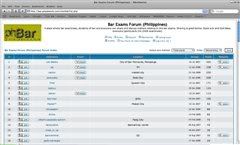
HOTSPOT: forum@phBAR

Photobucket
Looking for a cool place around? Look no further. It's the hottest place with the coolest people. Share and discuss legal matters, bar review, law school experiences, bar exams, current issues, anything and everything under the legal sun.

If not, you may just go through the articles and be by yourself. Who cares?

Join now and register. See yah!
(Click on image to go to site)

Friday, April 4, 2008

Case Digest: Neri v. Senate Committee

This is a case digest from a young collegiala by the pen-name SwityCake@phBAR. I'm posting it here in full and will go through it and add comments in the process.

From: switycake
To: raj
Posted: Fri Apr 04, 2008 3:20 pm
Subject: neri vs senate cmtes Quote message
Case Digest for Neri vs. Senate

FACTS:

A petition for certiorari1 was filed by petitioner Neri assailing the “show cause letter” dated November 22, 2007 and a subsequent order to cite petitioner in contempt more than a month later, January 30, 2008. Both documents were filed by the Senate Committees headed by the Senate Committee on Accountability of Public Officers and Investigations otherwise known as the Blue Ribbon Committee.

The antecedent events occurred previous to the issuance of the order and facts that have been culled up during the investigation are as follows:

The Department of Transportation and Communication (DOTC) entered into a contract with Zhing Xing Telecommunications Equipment (ZTE) on April 21, 2007 for the purpose of supplying equipment and services of a National Broadband Network (NBN) Project.

The full consideration amount of US$329,481,290 (Php 16 Billion) is to be financed by the People’s Republic of China.

In conjunction with the investigation, several resolutions to fill in legislative deficiencies were filed in Procurement law and executive-diplomatic treatises and agreements.

Simultaneously, this investigation resulted into the proposal of three pending bills in the Senate. Senate Bill No, 1793 was filed to subject treaties or executive agreements involving funding of projects to the scope of RA 9184 or the Government Procurement Reform Act.

Another bill was filed to impose safeguards in contracting loans classified as Official Development Assistance (ODA), and finally, a bill requiring concurrence to international and executive agreements.

The Senate Committees initiated the investigation by inviting officials and persons involved in the specified project. Secretary Romulo L. Neri was one of those invited to the hearings. On three occasions the Petitioner was invited, he only appeared once.

On another occasion the Respondent Committees invited Jose De Venecia, III who revealed that there were high officials pushing for the project. The project was originally to be realized manifested on a Build-Operate-Transfer (BOT) basis but soon, the witness found out it was converted into a government-to-government project. The aforesaid project involved the Republic of the Philippines and People’s Republic of China and is to be financed by a grant of loan by the latter.

Petitioner Neri who testified on September 26, 2007 disclosed that Commission on Elections (COMELEC) Commissioner Benjamin Abalos offered him a P200 million bribe to prioritize the project. That particular hearing lasted eleven hours. Neri, according to his testimony, immediately informed President Arroyo of the attempt him but he was instructed by her not to accept it.

However, when Neri was probed to elaborate on the matters pertaining to the NBN deal with the President, he refused to answer the question on the ground of executive privilege.

He refused to answer the following questions:

Whether or not the President followed up the NBN Project.
Whether or not she directed him to prioritize it.
Whether or not she directed him to approve.
Adamant as they could be, the respondent summoned the petitioner once again on November 20, 2007. However, Executive Secretary Ermita wrote on November 15, 2007 to dispense with Neri’s testimony as this was covered by executive privilege.

On the appointed date of the inquiry, petitioner did not appear in the proceedings. As a consequence, the Senate issued a show cause letter demanding that Neri to explain why he failed to appear before them and why he should not be cited in contempt.

The Petitioner replied that it was not his intention to snub the hearings and that he thought he was going to be asked the three remaining questions covered by executive privilege.

Moreover, with the assistance of counsel, Atty. Antonio R. Bautista, the Petitioner claimed that his non-appearance was upon order of the President and his conversation with her involved delicate national security and matters contingent to the impact of high ranking officials embroiled in bribery which probably results to loss of investor confidence in the country.

The Petitioner also requested that he be furnished with other questions in advance so he may adequately prepare himself.

When Senate’s inquiry was in recess, Petitioner filed a petition for Certiorari berating the show cause letter.

Meanwhile, Respondents found Neri’s explanation unsatisfactory and moved to cite him in contempt and to order the sergeant-at-arms to arrest and detain him at the Senate until such time he speaks up on the matter. Neri moved for the reconsideration of the above order. He alleged that he did not display a demeanor worthy of contempt and arrest. He reiterated that he was willing to accommodate any endeavor to shed light into the issue, provided he be furnished with questions in advance, a request which respondents did not heed.

On February 5, 2008 the Supreme Court issued a Status Quo Ante Order 2(a) enjoining respondents from implementing their contempt order, (b) requiring the parties to observe the status quo prevailing prior to the issuance of the contempt order and (c) requiring respondents to file their comment3.

Petitioner asserts that both the show cause letter and contempt order were issued with grave abuse of discretion amounting to lack or excess of jurisdiction. Again, petitioner underscores that any conversation or correspondence between cabinet members and the President are confidential since discussions involved the impact of exploring options in making policy decisions.

While Petitioner claims that the parameters have been laid down in Senate vs. Ermita, respondents insist the contrary. They argue that Neri’s testimony is substantial in the investigation in aid of legislation, that there is no valid justification for petitioner to claim executive privilege, that there was no abuse in discretion when respondent ordered the arrest of petitioner and that petitioner has not come to court with clean hands.

It was further ventilated by the respondent that the claim of executive privilege in this case will prejudice the right to public information clause, that the President ensure that he faithfully execute laws, that public office is a public trust, full public disclosure of all transaction of public interest, due process clause and the principle of separation of powers.

ISSUES:

Are the communications elicited by the subject three questions covered by executive privilege?
Did respondent Committees commit grave abuse of discretion in issuing the contempt Order?
DISCUSSION:

The court used Senate vs. Ermita as a sort of a yardstick in deciding this case. Senate makes a distinction between legislative and oversight powers of Congress quoting Sections 214 and 225 of Article VI of the Constitution.

The Senate describes that Section 21 relates that the power to inquire in aid of legislation is to gather information and improve lapses in legislation, while Section 22 pertains to the power of Congress to call for a question hour as it exercises its oversight power. The purported power is to ascertain that the executive branch does not arbitrarily exercise abuse of power.

In circumspect, the above distinctions as the court ruled gives birth to the interpretation of these two provisions. As respondents invoked Section 22, Article VI Congress cannot compel the appearance of executive officials. The court quoted Senate vs. Ermita on this matter.

The following are further elucidated by the court:

That the three questions are covered by executive privilege.
The power to investigate in the light of question hour may be broad but possesses limitations. To be valid it must be done in accordance to published rules of procedure of either houses and that rights of persons appearing be respected.
That in spite of the revocation of E.O 464, the executive privilege remains to due to its constitutional juncture.
The court makes distinction between the case at bar and the Nixon case. The latter involves a criminal prosecution and the former a congressional inquiry. The judicial department has to the power to compel persons to unveil confidential information in the administration of justice while the legislative has not even if it is a search for truth. An investigation in aid of legislation is not a judicial process to prosecute officials. Therefore, the privilege was properly invoked.
Petitioner did not act worthy of any contempt as he even subjected himself to an eleven-hour questioning.
The issue on the right to public information is subject to limitation as provided by law6.
The Senate failed to furnish petitioner his request of providing him questions in advance and include a publication its revised rules thus invalidating the contempt order.
The court further ruled that the right of the citizen of information is not equated with Senate’s power to summon officials or persons to an inquiry, vice versa.
Claim of executive privilege is properly invoked because the formal requisites mandate that it is the head of the department that initiates it and that it should be done in writing. It should also involve highly confidential information such as military secrets and diplomatic treatises to qualify for the privilege.
The Senate committed a grave abuse of discretion because besides a valid claim of executive privilege, they curtly disregarded petitioner’s reasons for abstaining from the inquiry. The responded still went ahead with the contempt order thus denying the petitioner due process of law.
With regard to the respondent’s allegation that the court abandoned its sacred duty to maintain the doctrine of separation of powers and check and balances in government, it simply proposed a negotiation as an alternate venue for settling controversies and avoid the cumbersome process of judicial review. It simply tried to avert a constitutional crisis looming in the horizon.
Respondent committee should have exercised the same restraint, after all, the petitioner is not even an ordinary witness. He holds a high position in a co-equal branch of government. This is concomitant with the doctrine of separation of powers and the mandate to observe respect to a co-equal branch of government.
RULING:

WHEREFORE, the petition is hereby GRANTED. The subject Ordered January 30, 2008, citing Romulo L. Neri in contempt of the Senate Committees and directing his arrest and detention, is hereby nullified.


1 An extraordinary writ issued by a superior court (as the Supreme Court) to call up the records of a particular case from an inferior judicial body. The Supreme Court may also use certiorari to review a decision by the highest court when there is a question as to validity of any treaty or statute on constitutional grounds.


2 An order directing parties to rescind or annul any contract or act and restore parties as if there was no act at all.


3 An expression of an opinion about a remark to a judge or prosecutor about evidence.


4 The Senate or House of Representatives or any of its respective committee may conduct inquiries in aid of legislation in accordance with its duly published rules of procedure. The rights of persons appearing in or affected by such inquiries shall be respected.


5 The heads of department may upon their own initiative, with the consent of the President, or upon the request of either House, or as the rules of each House shall provide, appear before and be heard by such House on any matter pertaining to their departments. Written questions shall be submitted to the President of the Senate or the Speaker of the House of Representatives at least three days before their scheduled appearance. Interpellations shall not be limited to written questions, but may cover matters related thereto. When the security of the state or the public interest so requires and the President so states in writing, the appearance shall be conducted in executive session.


6 Section 17, Article III – The right of information on matter of public concern shall be recognized. Access to official records, and to documents, and papers pertaining to official acts, transactions, or decisions, as well as to government research data used as basis for policy development, shall be afforded the citizen, subject to such limitations as may be provided by law.

_________________
Fiat justitia, ruat coelum
View user's profile Send e-mail Yahoo Messenger

Reply to message All times are GMT + 8

----------------------------------------
COMMENTS on the Digest:
1. As a rule of thumb, case digests must be limited to the space of a single piece of yellow pad paper.
2. There is no need for footnotes and the use of elaborate sentences. They are meant to be used by those who are in the legal profession for the purpose of a quickglance.
3. It must be compressed. For example, on the paragraph in the Decision portion that goes.."WHEREFORE, the petition is hereby GRANTED. The subject Ordered....", it would be sufficient to write, "Petition was approved"or"Petition GRANTED." Stating therein the 'rationale' and the 'basis' in law or statute, administrative act, ordinance and regulation. Also the basis in 'equity.'
4. Define the body distinctively. Facts, Issues, then Decision. They should be numbered if there are several contents in each category.
5. Use your own words. Try not to be part of the 'copy-paste battalion.'
Not bad for a start. Amazing in fact. Like they say... "the next is always the best", SATISFACTORY!

Further COMMENTS:
It is unmistakable that the SC has committed a fallacy of argument by attacking the legitimacy of the conduct of the Senate Committee. Under Aristotelian lines it provides;

Attack Fallacies: The best form of defense is sometimes thought to be attack. When an argument is failing, many people will go on the offensive, seeking to destroy the other person's confidence rather than their argument.

Poisoning the Well: Discrediting the person before they speak.


For lack of a better argument. It resorts to saying that the Senate Rules needs to be published. The Senate has spoken by saying that being a continuing body there was no need to re-publish its already long published rules. Only the preceding amendments to its rules needs to be published.

It appears that we have come full circle. What we have now is a Supreme Court that is virtually under trial.

A motion for reconsideration in this instance therefore is to give the court a chance to correct itself.


The most perfidious way of harming a cause consists of defending it deliberately with faulty arguments.
[info][add][mail]
Friedrich Nietzsche,

Thursday, April 3, 2008

ISSUE: Lowering The Average

The only issue left regarding the 2007 bar examination was the lowering of the passing mark. Its been some seven years since the Supreme Court decided on it last. Now, what are the main scenarios that would instigate a negative reaction?

Questions, questions..
1. Was there a possibility that information as to the result was leaked in advance in order to favor a few selected candidates? This is not a far-fetched idea considering the state of advanced communications.Its also a fact that somehow someone happens to be well connected with the powers that be.

2. Under what possible circumstances na hindi nagkaroon ng piring ang katarungan?

3. Does the structural setup of the Examination Body ensure reasonable fairness?
It's who knows What and When.

This is not to degrade the level or quality of the passers. Here, the conduct of the Supreme Court may be questioned by the Legislature with respect to the Rules and Mechanics to ensure fairness in the function. Through a legislative act. I suppose. Even through a "legislative inquiry in aid of legislation." After all, the power of the purse has the right to know as to whether or not government funds are spent in furtherance of a good government act. The doctrine parens patria dictates that the children are treated equally without favoritism.

Does the judiciary have an exclusive domain? I should say no. They're separate yet meant to fuse and compliment each other. That is to correct lapses in any branch of government. It's who you know that matters? MBA( May Backer Ako)? Culture of corruption and institutionalized greed? They carry that kind of corrosive attitudinal substance in a Republic.

When things like these matters are questioned. It is not fair even to the passers. They have the effect of a Pyhrric and hollow victory. They are robbed of a once in a lifetime state of self-confirmation and validation.

Ever wondered why even the blind are able to acquire a driver's license in our country?

REFORMS, reforms?
Enough of the deity type of examiners correcting the notebooks. It should be broadly assimilated. Any lawyer should qualify in a Body of Correctors. After all, the law is suppose to be understood by even the least of educated or learned and by all. Surely every lawyer is qualified to correct.

It could be on a voluntary or with a little financial reward per booklet corrected. This would hasten the process and cut-down the very long agonizing wait for the results.

Avoid subjectivity by allowing the use of laptops and computer software in the actual examination. We are no longer in 1901. We are living in the age of rapid technological advances. Eliminating the very subjective 'hand-writing' factor. As an excuse for an examiner being in a bad mood.

Its not that I have a bad penmanship. On the contrary, it has received numerous praises and admirations to the point that it no longer affects me.


FUTURE PREJUDICE: The adjusted average would tend to affect future examinations like the following year's exams in case it would result in a average lower than that which was allowed this year. Indeed, if they go below the average passing mark relative to the number of examinees and the ration with this in relation to this years results then that would proly result for clamor for an adjustment from those who did not make it. Indeed this year's results cannot be higher than any succeeding result based on comparative statistical data.

So, the proof of the pudding is in the eating. The result is a constipated effect.LOL.

Wednesday, April 2, 2008

Review Season

It's the season for review once more. These are times when formal review commences in many centers.

Aside from the standard commonly known review venue's, here's a list of alternative review centers.

I. Review classes every Saturday & Sunday from 8:00 a.m. to 5:00 p.m. starting 29 March 2008 to 24 August 2008.

Venue: Gapuz Centrum II, T. Alonzo
Street, New Lucban, Baguio City

Practical BAR Techniques + Comprehensive Review Materials +
BAR Ops + Tuition payable on Installment Basis +
100% Personalized Service

For more information, please call
(074) 446-5724 or (02) 893-4158

Brought to you by:
*Fortun Narvasa & Salazar Law Offices
*RA Gapuz Review Center
*Frontier Neo-solutions & Systems Corporation

http://www.fnslaw.com.ph/

http://www.legaladvantage.com.ph/


Kindly convey this message to friends and colleagues.


II. Hi,

My name is Zigfred Diaz. I a Cebu based lawyer and law professor. If you wish to know more about me check out my blog www.zdiaz.com

My desire is to help law students to hurdle the bar exams. I have lots of idea that could help bar examinees. Currently I am finishing volume I of my book, the Lex Pareto Notes. Volumes 2,3 and 4 are already finished. We will be transferring our website in the meantime you can check out the existing site www.lexparetonotes.8m.com. I will be posting information about the Lex Pareto Notes after we finish our new website.

I am also helping promote a Manila based bar review center here in Cebu, the Jurists Bar Review center. If you want to know more about it checkout the website at
www.juristsbar.com.ph


To all those who are aspiring to make it to the noblest of profession, just message me if there is anything I could do to help you in your journey.

Atty. Z


PLS. feel free to contact me for an ADD to the list.
raj
__________________________________
OPERATING COST:

This is a list of incurrable expenses:
Venue: MetroManila/suburbia

1. Bar review fee P12,000
2. Board and Lodging (P6000x 5months) 30,000
3. Food and other incidentals (200x30x6) 36,000
4. Bar fees and others 3,000
5. Transportation cost 7,000
6. Board and Lodging in Manila (optional-1 month) 6,000
8. Other expenses (buffer money) 5,000

Estimated Expenses (April 1-September 31) P100,000
(thanks to Joshuu@phBAR)

Sunday, March 30, 2008

The 2008 PhBarExams Result

To the new lawyers I could have decided to spruce up this post with fireworks exploding in the heavens. I couldn't imagine a more fitting scenario for a celebration. However, considering the already graphically heavy page loading made me decide against it.

For those who did not make it. It would be well to note that the pursuit should be continued at all cost despite the setback. After all there's still more strikes left and the next try almost always increases the chance to near certaintyof passing. I hope that the time spent waiting was indulged in fine tuning the knowledge and honing one's own database to confirm one's given answers. Then the next try will surely be less of an effort. "Kung saan ka nadapa, 'dun ka bumangon."

It amuses me to find out at the PDI website that article which displayed the banner: " Regalado Record Still Unbroken." I believe that each bar exam is unique and different considering the broadness of its coverage. Inspite the fact that they cover same eight subjects.

I should therefore say that if Regalado were to take the Bar Exams at present, he would most proly flunk. Or as a consolation, maybe only pass Remedial Law. nyahaHAH!

Best of Luck Guys!

******click on post title for more info on the BarEx.

Tuesday, March 25, 2008

G.R. No. 180643 on Executive Privilege

Photobucket

The en banc decision of 9-6 is in itself telling of the matter. I am reminded of my professor in the college of law who said: "watch for the dissenting opinions, they tend to be the dominant stand and will sooner or later prevail.

Here are some substantial points I gathered as I went through the ponecia. I do admit that I was more absorbed in the dissenting opinion of the Chief Justice. Which is very methodical, forceful, and strong.

1. ..And third, there is no adequate showing of a compelling need that would justify the limitation of the privilege and of the unavailability of the information elsewhere by an appropriate investigating authority.
----------------------------------------
COMMENT: A confirmed act of bribery is not compelling enough?

2. ...in relation to her executive and policy decision-making process and diplomatic secrets.

3. ...we think the sufficiency of the Committee's showing must depend solely on whether the subpoenaed evidence is demonstrably critical to the responsible fulfillment of the Committee's functions.
------------------------------------


4. Thus, while Congress is composed of representatives elected by the people, it does not follow, except in a highly qualified sense, that in every exercise of its power of inquiry, the people are exercising their right to information.
----------------------------------------------
Comments: Due to the fact that The Senate is the only constitutional body that is elected broadly on a national level, it is closest to the Sovereign Collective Will of the people acting as an assembly. In contrast with that of the Lower House whose representative is elected by district one per 500k of the population. Besides, whatever grandstanding that may be maliciously attributed to an inquiry is very much overshadowed by the need for the people to know what is really happening in the corridors of power. After all it is the ordinary citizen who carry's the burden of paying taxes. It is not only a matter of transparency but also accountability.

5. The context in which executive privilege is being invoked is that the information sought to be disclosed might impair our diplomatic as well as economic relations with the People’s Republic of China. Given the confidential nature in which these information were conveyed to the President, he cannot provide the Committee any further details of these conversations, without disclosing the very thing the privilege is designed to protect.
-------------------------------
Comment: This is the justification of Sec. Ermita with regard to invoking the 'executive privilege'. just one question sir, what kind of diplomatic and economic relation with China are you trying to protect? I did not know that bribery is being protected by the government. Are you saying that it is the policy of China to bribe foreign governments and that the relationship is reciprocal? It is therefore safe to say and logical given the premises that it is the policy of the present government to accept and negotiate for bribes.However, policy is a matter of public interest. You see sir, you are caught up in your 'web of lies'.

6. Justice Reed, sitting on the U.S. Court of Claims, wrote: “The power must lie in the courts to determine Executive Privilege in litigation.... (T)he privilege for intra-departmental advice would very rarely have the importance of diplomacy or security”.


7. Thus, as early as 1807, the Burr case established the doctrine that the President's authority to withhold information is not absolute, the President is amenable to compulsory process, and the interests in secrecy must be weighed against the interests in disclosure.[83]

8. The administration of President Richard Nixon produced the most significant developments in executive privilege. Although his administration initially professed an “open” presidency in which information would flow freely from the executive to Congress to the public, executive privilege during this period was invoked not for the protection of national security interests, foreign policy decision-making or military secrets as in the past, but rather to keep under wraps politically damaging and personally embarrassing information.

9. The history of executive privilege shows that the privilege is strongest when used not out of a personal desire to avoid culpability, but based on a legitimate need to protect the President’s constitutional mandate to execute the law, to uphold prudential separation of powers, and above all, to promote the public interest.


10. The ground involved in the case at bar, as stated in the letter of Secretary Ermita, is Presidential communications privilege on information that “might impair our diplomatic as well as economic relations with the People’s Republic of China.”


11. While the Court alluded to U.S. v. Nixon and made pronouncements with respect to Presidential communications, a closer examination of the facts of Almonte would reveal that the requested information did not refer to Presidential communications, but to alleged confidential government documents. Likewise, U.S. v. Nixon specifically confined its ruling to criminal proceedings, but Almonte was about a prosecutorial investigation involving public interests and constitutional values different from a criminal proceeding.

12. Such information, however, must pertain to definite propositions of the government, not necessarily to intra-agency or inter-agency recommendations or communications during the “exploratory” stage.

13. In this case, the Court again alluded to U.S. v. Nixon and also recognized that Presidential communications fall under the mantle of protection of executive privilege in the setting of a legislative inquiry. But since the issue for resolution was the constitutionality of EO No. 464 and not whether an actual Presidential communication was covered by the privilege, the Court did not have occasion to rule on the same.

14. “Whatever the nature of the privilege of confidentiality of Presidential communications in the exercise of Art. II (presidential) powers, the privilege can be said to derive from the supremacy of each branch within its own assigned area of constitutional duties. Certain powers and privileges flow from the nature of enumerated powers; the protection of the confidentiality of Presidential communications has similar constitutional underpinnings.”[128] In this case, the Special Prosecutor seeking access to the tape recordings of conversations of the President argued that the U.S. Constitution does not provide for privilege as to the President’s communications corresponding to the privilege of Members of Congress under the Speech and Debate Clause. But the Nixon Court disposed of the argument, viz: “(T)he silence of the Constitution on this score is not dispositive. ‘The rule of constitutional interpretation announced in McCulloch v. Maryland, 4 Wheat. 316, 4 L.Ed. 579, that that which was reasonably appropriate and relevant to the exercise of a granted power was to be considered as accompanying the grant, has been so universally applied that it suffices merely to state it.’”

15. It is not to be used to personally benefit the person occupying the office. In In re Subpoena for Nixon[172] Chief Judge Sirica emphasized, viz: “… [P]rivacy, in and of itself, has no merit. Its importance and need of protection arise from ‘the paramount need for frank expression and discussion among the President and those consulted by him in the making of Presidential decisions.’”[173] In Kaiser Aluminum & Chemical Corp. v. United States,[174] in which the term “executive privilege” was first used, the U.S. Court of Claims emphasized that executive privilege is granted “for the benefit of the public, not of executives who may happen to then hold office.”

comments: This is the most glaring truth that beckons as a guiding light in the quest for truth and justice.

16. ...the clash of powers between the executive and the legislature must be resolved in a manner that will best allow each branch to perform its designed functions under the Constitution, using the “function impairment test.” In accord with this test, it is the Court’s task to balance whether the disclosure of the disputed information impairs the President’s ability to perform her constitutional duty to execute the laws more than non-disclosure would impair the respondent Senate Committees’ ability to perform their constitutional function to enact laws.

1
7. Finally, the following statement of Dorsen and Shattuck is instructive

x x x there should be no executive privilege when the Congress has already acquired substantial evidence that the information requested concerns criminal wrong-doing by executive officials or presidential aides. There is obviously an overriding policy justification for this position, since the opposite view would permit criminal conspiracies at the seat of government to be shrouded by a veil of an advice privilege. While the risk of abusive congressional inquiry exists, as the McCarthy experience demonstrates, the requirement of “substantial evidence” of criminal wrong-doing should guard against improper use of the investigative power.


-----------------------------------------
misc. comments:
@phBAR:
raj: I was taken aback by the SC decision on the Neri case. The ponecia was very shallow and lame. However, I was appeased by the dissenting opinion of the Chief Justice which was very thorough, incisive, and enlightening.

If you try to place the two side-by-side with each other. You will find the other a 'shame'.

Thank you CJ Puno for your decision!
-----------------------------------------
It seems to me that Executive Privilege may only be exercised in the absence of an irregularity or abuse. It cannot be invoked in the presence of a controversy. One, there is a need for a document that should be released to the public as a result of the executive-decision-making-process. In the presence of such an existing public document which binds the government in a contract, the process of coming into a decision may not be looked into. This is candor in communication and executive interaction. Herein lies a valid exercise of the privy. 'Nawala ba yung contract'?, all the more is there a need to demolish the invocation of the privy. Stinks of a cover-up! Rule on presumption of evidence: The person having possession of an evidence is presumed to be negatively affected if the evidence is disclosed or the non-disclosure of such an evidence by a person who is presumed to possess it by virtue of an office in the regular performance of a duty /responsibility/function may be held liable in the presence of an allegation of wrongdoing and will incriminate the person charged.

Again, it is exercised with a presumption of regularity of performance. That indeed, the President has decided in good faith and in the observance of the proper conduct in arriving at such a decision. While a questionable contract decided on should never be shielded by such a privy. Pure common sense.


The most perfidious way of harming a cause consists of defending it deliberately with faulty arguments.
[info][add][mail]
Friedrich Nietzsche,

Wednesday, March 19, 2008

Que Barbaridad!

----------------------------------------------


"Hell hath no fury like a woman (gay in this case..does it matter?) scorned"
Check the link
HERE while it's hot! Have some fun..


---------------------------------------------
Comments:

The blogging phenomenon flexes its muscle. A clear manifestation of unrestrained communication and interaction moderated only by a blogger's account owner. Gone are those days were information was dominated by the few who control channels of public information in a country that has been through hundreds of years of colonial influence and subservience.

These things could not have been made possible without the advances in technology and Internet revolution. It breaks through barriers and boundaries of jurisdictional questions. Questions which have yet to be settled in a world that is increasingly becoming 'a world without strangers'. Instant and spontaneous, it has become a place that generates new realizations which is only possible in our time and age.

On starting off, here is a quote on the Propaganda: Dictator's Three Friends.

One of the key things that any dictator knows is that in order to achieve absolute control, they need to have control of the military, the media and education.

Military

The military and police offer the crudest and most absolute forms of control. When you can physically restrict people, locking them up or shooting them, then all dissidents will go in fear and very few will dare open their mouths.

Yet using military might is not a good solution. When coerced, you will get control of hands, but not hearts or minds. Rebellion is always in the air and the dictator will always go in fear of his or her life.

Media

When you control the media, you can control the messages that are put in front of people day in and day out. If all that people see is a consistent message, then they will eventually come to believe it.

The internet has caused problems for dictators here, as has telephones and all other electronic forms of media that allow foreign ideas to worm their way into the system.

Education

When you control the education system, you can instill values and beliefs from a very young age, particularly if you can move them from any contrary family environment into a consistent and controlled system.

The Jesuits are famous for starting with the very young, with the chilling declaration 'Give me the child and I will give you the man'. Values that are instilled when young may disappear for a while during teenage years, but almost always creep back again afterwards.


-------------------------------------
reminders:

1. statute of frauds.
2. law of e-commerce.
3. rules on electronic evidence.
4. libel (good for int'l. exposure)..maybe realize how our laws suck?